 Sunset on the Swilly
Tuesday, 4 December 2007


A FEW JOBS TO DO

Frosty broccoli
The thought of going outside to do a bit of gardening might appear to be a crazy one, but it’s not that bad when you are out there. It’s a good time to go around and have a look at your deciduous trees and shrubs now. Prune trees that are getting to be a nuisance by growing over paths, near telephone wires, or too close to the house.
Leave flowering shrubs such as forsythia, spirea and quince as they are spring flowering and you don’t want to chop off all of the flower buds. Leave them until after they have flowered in late spring before you trim them.
Prune established fruit trees such as apples and pears (leave stone fruit such as plums and peaches as they could get fungal diseases in the damp weather) Remove any diseased or dead wood from the tree and cut out branches that are crossing one another. Opening the tree out like this will give the fruit the maximum amount of sunshine come the summer.
Leave flowering shrubs such as forsythia, spirea and quince as they are spring flowering and you don’t want to chop off all of the flower buds. Leave them until after they have flowered in late spring before you trim them.
Prune established fruit trees such as apples and pears (leave stone fruit such as plums and peaches as they could get fungal diseases in the damp weather) Remove any diseased or dead wood from the tree and cut out branches that are crossing one another. Opening the tree out like this will give the fruit the maximum amount of sunshine come the summer.
MAYO ANIMAL WELFARE

DOG AND WILD ANIMAL WELFARE & RESCUE
NAME:
MAYO ANIMAL WELFARE
ADDRESS:
Honey Cottage, Buckfield, Kilmeena, Westport
PHONE:
(098) 41484
CONTACT:
Noeline Haylett
SPECIAL NOTES:
We have many puppies and older dogs of different breeds, all in desperate need of homes.
ABOUT:
Bank Account: Ulster Bank Westport, Acc. No. 44715043
Mayo Animal Welfare is a voluntary organisation whose members are dedicated to the welfare of animals in the County. It was established in April 1994. The work of the organisation mainly involves:
The rescue of abandoned, cruelly treated and injured animals. Caring for pets in case of sickness/death of owner. Rehoming of animals. Releasing wildlife such as swans,hares,seabirds etc. into their natural habitats after treatment for injuries. The organisation runs regular spaying/neutering discount campaigns where people receive a 40% discount of the normal spaying/neutering price. Contact the above number for more details.
We receive some funding from the Ministry or Agriculture and rely on donations and fundraising. As Mayo does not have an Animal Sanctuary members take rescued animals into their own homes and care for them at their own expense. If you can, please help us to fund the ongoing neutering project by subscribing to Mayo Animal Welfare, as little as €1 per month can make a difference.If you can provide a good home for an animal please contact Noeline at (098) 41484.
NAME:
MAYO ANIMAL WELFARE
ADDRESS:
Honey Cottage, Buckfield, Kilmeena, Westport
PHONE:
(098) 41484
CONTACT:
Noeline Haylett
SPECIAL NOTES:
We have many puppies and older dogs of different breeds, all in desperate need of homes.
ABOUT:
Bank Account: Ulster Bank Westport, Acc. No. 44715043
Mayo Animal Welfare is a voluntary organisation whose members are dedicated to the welfare of animals in the County. It was established in April 1994. The work of the organisation mainly involves:
The rescue of abandoned, cruelly treated and injured animals. Caring for pets in case of sickness/death of owner. Rehoming of animals. Releasing wildlife such as swans,hares,seabirds etc. into their natural habitats after treatment for injuries. The organisation runs regular spaying/neutering discount campaigns where people receive a 40% discount of the normal spaying/neutering price. Contact the above number for more details.
We receive some funding from the Ministry or Agriculture and rely on donations and fundraising. As Mayo does not have an Animal Sanctuary members take rescued animals into their own homes and care for them at their own expense. If you can, please help us to fund the ongoing neutering project by subscribing to Mayo Animal Welfare, as little as €1 per month can make a difference.If you can provide a good home for an animal please contact Noeline at (098) 41484.
NATIONAL GARDEN EXHIBITION CENTRE-GABION BASKETS

I was after a bit of design inspiration last week so I took myself down to The National Garden Exhibition Centre in County Wicklow. This centre has been open for two decades and exhibits twenty showcase gardens planned by the countries leading designers. The gardens are mostly quite conservative but there are new designers coming in and putting a contemporary feel into some of the corners. One garden has loads of vertical ten-foot planks everywhere to give you a feeling of three-dimensional space; they are painted white just in case you might bump into them!
GABION BASKETS
The choices of materials for the paths were interesting to see and I was taken by one design in particular that used Gabion baskets for their main structural design. These baskets are usually used for retaining riverbank walls or keeping hillsides from falling onto the road when it carves through a hillside. They are made from an open weave of galvanised steel and some have a plastic coating. A basket has a guarantee of one hundred years as well! In this garden design the Gabion baskets have been filled with choice, quality stone (some of it from Donegal) to make a fantastic border to the lawn and patio area the style is of a nautical nature and there is also a full sized sail in the garden on the patio. It is not to everyone’s taste I would imagine, using materials such as this will always have its critics, but it would be a great talking point if it was on your own plot. For more information check out the Phi website www.phiireland.ie
GABION BASKETS
The choices of materials for the paths were interesting to see and I was taken by one design in particular that used Gabion baskets for their main structural design. These baskets are usually used for retaining riverbank walls or keeping hillsides from falling onto the road when it carves through a hillside. They are made from an open weave of galvanised steel and some have a plastic coating. A basket has a guarantee of one hundred years as well! In this garden design the Gabion baskets have been filled with choice, quality stone (some of it from Donegal) to make a fantastic border to the lawn and patio area the style is of a nautical nature and there is also a full sized sail in the garden on the patio. It is not to everyone’s taste I would imagine, using materials such as this will always have its critics, but it would be a great talking point if it was on your own plot. For more information check out the Phi website www.phiireland.ie
Monday, 3 December 2007
HEBE

I would like to add some evergreen shrubs to different areas of my new garden. I like the looks of the leathery plants that you see in established gardens. I think they are called Hebes. I do not have much time for the garden so they would have to be easy to look after, would they be OK?
One plant that we do see in abundance here in Inishowen is the Hebe. These plants have stood the test of time and are well able to cope with both our summers and our winters. The plants originated from New Zealand, Australia and South America and would be more than at home in your garden. There are loads of different types to choose from, whether you want a large formal hedge or a small variety for use in a dry rockery. The flowering period can be quite long and some varieties actually produce blooms twice a year. The colours range from white through pink to blue and purple. It was the purple types that were first planted because they were thought to be the hardiest, but all of the other coloured shrubs are as tough. The shrubs offer a year round interest of different varieties of waxy foliage. If you are looking at the plants out of flowering season then as a rule the lighter the leaf, the lighter the flower colour. If you are buying from a garden centre then they should have labels anyway. You will be pleased to know that the plants need very little or no maintenance, just remove any dead stems if you see them.
TEASEL
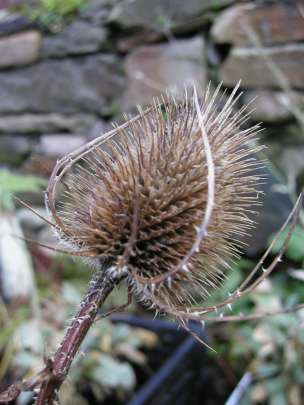
The frosts that we have really highlight the beauty of plant structures. Neglected gardens are particularly noticeable with last year’s dead growth of the perennials being covered with white crystals. I say this because my garden hasn’t really been touched since last summer and I’m very pleased with the results. So are the birds, they take shelter in the large amount of undergrowth when they are feeding on the food that I put out for them. Last years growth protects the new shoots that are appearing now, it won’t be long before we see the daffodils out. It isn’t just the garden that looks beautiful at this time of the year. Look in the hedgerows when you are out for a walk and you will see all sort of interesting things happening. If you are lucky you could see the remains of old teasels. Teasels are fascinating plants that seem to appear out of nowhere. They are usually seen on roadsides, disturbed waste ground and in unused quarries. The plant is native to here and gets its name from its former use for raising the nap on cloth, teasing it out with the spiky seed heads. Teasel Dipsacus fullonum, was obviously grown in bygone times for this purpose. The plants are still popular to-day but are grown for a more ornamental purpose. People like to use the decorative seed heads in dried winter flower arrangements. The seeds are shed from these if they are left to mature and they can pop up, years later, often in unexpected places. The teasel is given credit for attracting goldfinches into the garden, but they probably attract more species, as the seeds will be an attractive addition to the winter menu. Another plant that you might see in the hedgerow is soapwort.
Subscribe to:
Posts (Atom)
Other stories
